

Clear aligner therapy has transformed the way orthodontists and dental professionals approach tooth movement. Digital treatment planning, increasingly sophisticated software, and improved aligner materials have made it possible to treat a wide range of patients with clear aligners.
But as more practices incorporate clear aligners into their workflows, an important question remains:
How do you make clear aligner treatment more efficient, predictable, and repeatable?
The answer isn’t simply creating a better digital setup or trying to complete an entire case in one series of aligners. True efficiency comes from having a system for treatment planning, staging, monitoring, and finishing.
At Ultimate Orthodontic Academy, Dr. Michael Bicknell approaches clear aligner treatment through a structured three-phase system designed to break a complex treatment plan into manageable stages. The goal is to create a predictable path from the initial diagnosis to the final result while allowing the clinician to evaluate and optimize the case along the way.
Efficiency Starts With the Treatment System, Not the Aligner
It can be tempting to think of clear aligner efficiency as simply reducing the number of trays or shortening treatment time. But fewer aligners does not necessarily mean a more efficient case. A treatment can become inefficient when clinicians are forced to repeatedly rescan, restart, modify treatment plans, or order additional refinements because the original sequence attempted to accomplish too much at once.
Instead, efficient clear aligner treatment starts with a different mindset:
Don’t try to finish everything at once. Build a system that allows you to reach the final result predictably.
This means identifying the major objectives first, establishing the foundation of the case, and then progressively refining the result.
It is the difference between simply having a treatment goal and having a repeatable process for reaching that goal.
Why Clear Aligner Treatment Needs a System
Every orthodontic case has a destination.
The challenge isn’t necessarily knowing what the final result should look like. The challenge is determining how to get there while managing the three dimensions of tooth movement, occlusion, esthetics, and the limitations of the appliance.
Clear aligner treatment adds another layer of complexity because the clinician is working within a digital environment where movements can appear achievable on a screen long before they are proven clinically.
A strong treatment system helps answer questions such as:
- What needs to happen first?
- Which movements establish the foundation for the case?
- Which objectives can be addressed simultaneously?
- Which movements require additional control?
- When should the clinician reassess the treatment?
- What should be addressed before entering the finishing stage?
Rather than asking the aligner to accomplish everything in one sequence, a phased approach creates checkpoints throughout treatment.
That can make complex cases easier to manage for both the doctor and the clinical team.
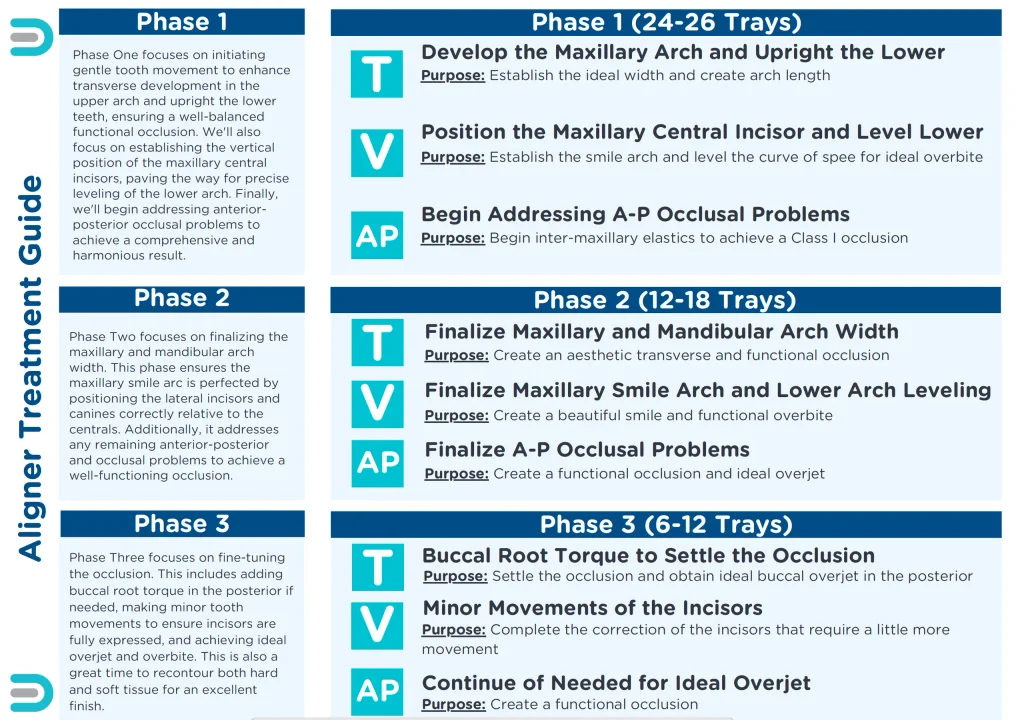
Dr. Bicknell’s 3 Phases of Treatment
The foundation of the UOA approach to clear aligner treatment is a three-phase structure:
Phase 1: Foundation & Direction
Phase 2: Expression & Optimization
Phase 3: Completion & Finishing
Each phase has a distinct purpose.
The objective isn’t simply to divide the aligners into three groups. Each phase represents a different clinical mindset and a different point in the progression of the case.
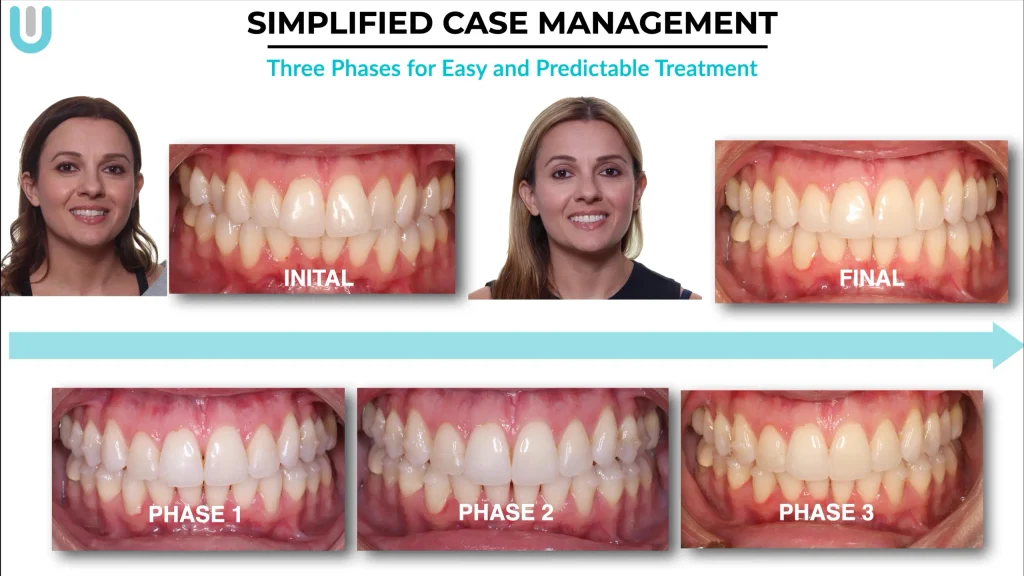
Phase 1: Foundation & Direction
The first phase is about the major movements and establishing the overall direction of treatment. Before focusing on the small details, the clinician needs to create the foundation upon which the rest of the treatment can be built.
This includes thinking about the major components of orthodontic correction:
- Transverse development
- Arch form
- Vertical relationships
- Sagittal correction
- Smile arc
- Occlusal relationships
For example, in a patient with crowding, simply moving anterior teeth forward may not always be the most appropriate way to create space. Establishing an appropriate arch form and understanding how transverse development contributes to available arch length can change the way the case is approached.
Likewise, vertical objectives cannot be considered independently of the occlusion. Positioning the anterior teeth appropriately requires consideration of the opposing arch and the functional bite.
Phase 1 is therefore about establishing the foundation and direction, not trying to perfect every detail.
That distinction is important.
A common source of inefficiency in clear aligner treatment is attempting to finish the case in the first series of aligners. While it may seem efficient to program everything at once, doing so can make it more difficult to identify which movements have been fully expressed and which still require attention.
A phased approach creates an opportunity to reassess the case after the major movements have occurred.
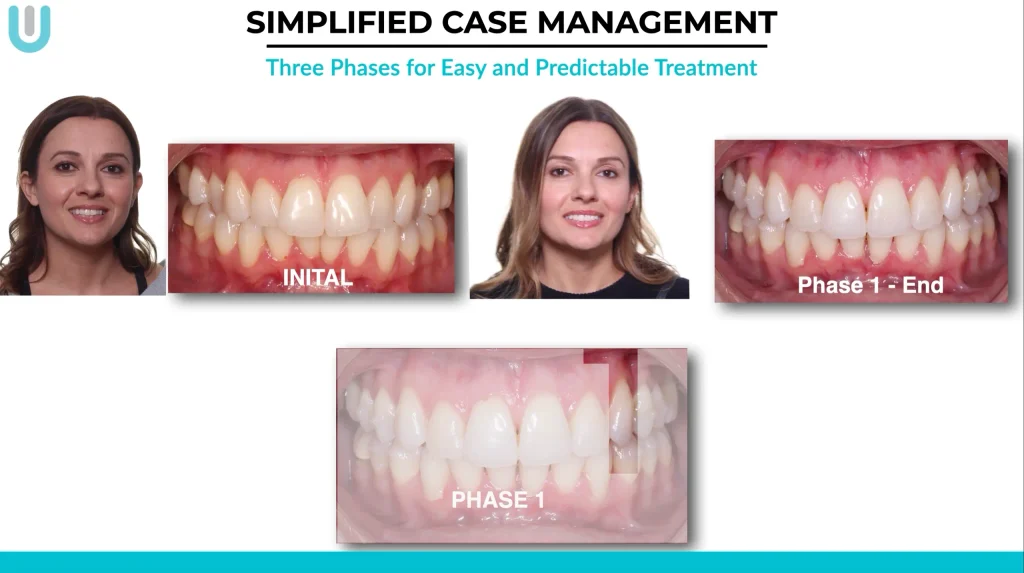
Phase 2: Expression & Optimization
Once the foundation is established, the focus shifts.
Phase 2 is about expression and optimization.
The major objectives have been addressed, but the clinician can now evaluate how fully those movements have expressed and identify what needs to be optimized.
This is where details such as:
- Arch form
- Occlusion
- Smile arc
- Tooth position
- Torque
- Transverse relationships
- Interproximal relationships
- Elastic mechanics
become increasingly important.
One of the key concepts in this phase is recognizing that what was planned digitally does not always express exactly as expected clinically.
That isn’t necessarily a failure of treatment planning.
It’s part of orthodontic treatment.
Biology, tooth morphology, appliance mechanics, compliance, and the interaction between different movements can all influence how a case progresses. Rather than treating those differences as unexpected problems at the end of treatment, Phase 2 provides a deliberate opportunity to identify and optimize them.
This is also where the clinician begins transitioning from simply moving teeth to expressing the intended result.
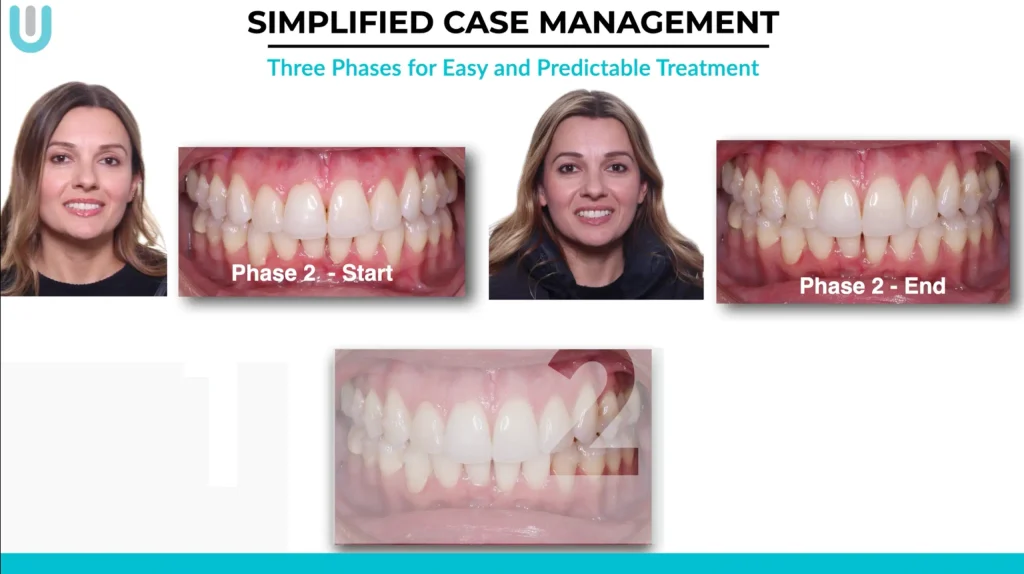
Phase 3: Completion & Finishing
Phase 3 is where the details matter.
By this point, the major movements should already be addressed. The focus shifts toward completing the case, refining tooth positions, settling the occlusion, and addressing the smaller details that can make the difference between a case that looks good and a case that looks truly finished.
Phase 3 may involve considerations such as:
- Minor tooth positioning
- Final space closure
- Final torque
- Occlusal settling
- Anterior alignment
- Smile arc refinement
- Tooth contour and proportions
- Hard and soft tissue considerations
- Retention planning
This is also the point where patient perception becomes particularly important. A patient may be satisfied with the broad result but still notice a small detail that matters significantly to them. That’s why finishing shouldn’t be treated as an afterthought.
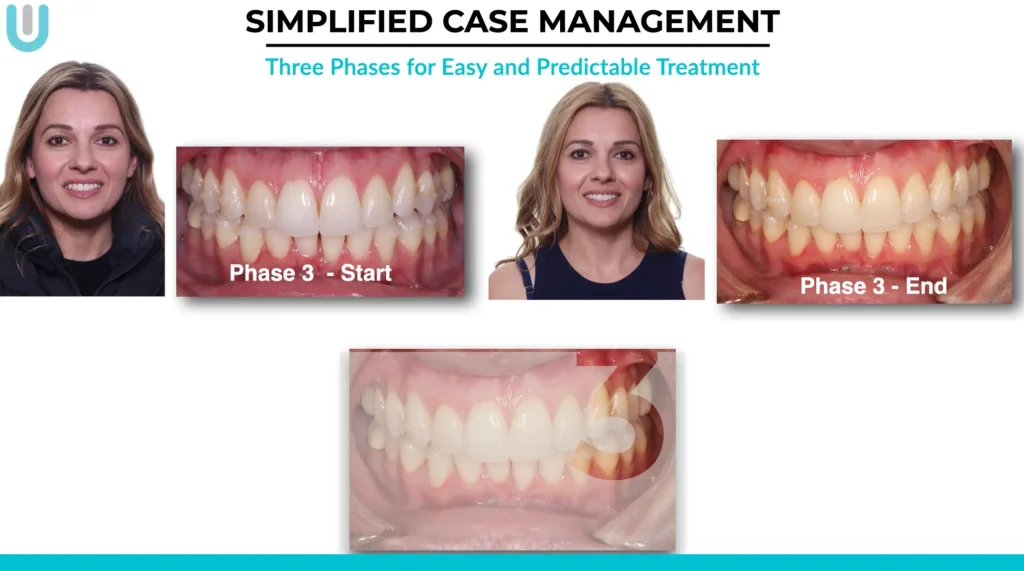
The Patient’s Definition of “Finished” Matters
One of the most important concepts in efficient treatment isn’t purely biomechanical.
It’s communication.
Patients enter orthodontic practices with expectations that may have been shaped by social media, online before-and-after images, advertising, or increasingly sophisticated digital and AI-generated imagery.
Some expectations may be realistic.
Others may be unspoken, unrealistic, or outside the scope of what orthodontic treatment alone can accomplish.
A clinically excellent result does not automatically guarantee a satisfied patient if the patient’s expectations were never identified.
This is why the three-phase approach extends beyond tooth movement.
The goal is to create checkpoints throughout treatment so that the doctor and patient remain aligned on what the final result should accomplish.
By the beginning of the finishing phase, there should be very few surprises.
The clinician should know what remains to be addressed, and the patient should understand what the finishing process is intended to accomplish.
Clear Aligner Efficiency Requires Thinking in Three Dimensions
One of the biggest advantages of a systematic approach is that it prevents clinicians from looking at clear aligner treatment as simply an alignment problem.
Orthodontic treatment occurs in three dimensions.
Transverse
Arch width and arch form influence available space, tooth position, and overall occlusion.
Vertical
The vertical position of the anterior and posterior teeth plays an important role in smile esthetics and functional occlusion.
Sagittal
The relationship between the arches must be considered alongside the other dimensions rather than treated as an isolated correction.
These dimensions interact.
A change made in one dimension can influence what happens in another. That is why clear aligner treatment planning requires more than simply selecting individual tooth movements in a digital setup.
The movements have to work together.
The Importance of Staging Clear Aligner Movements
Clear aligner staging is one of the most important components of treatment efficiency.
The question isn’t simply:
“What movements do I need?”
It is:
“What needs to happen first?”
A well-designed sequence considers the relationship between movements and determines which objectives establish the conditions necessary for subsequent corrections.
This is particularly important when treating cases involving:
- Significant crowding
- Transverse discrepancies
- Vertical discrepancies
- Sagittal correction
- Complex tooth rotations
- Space closure
- Smile arc changes
- Occlusal discrepancies
The goal is not to force every objective into a single aligner sequence.
The goal is to create a progression in which each stage moves the case closer to the intended destination.
From Major Movements to Minor Details
This is the fundamental concept behind the UOA three-phase approach.
Think of the treatment progression as moving from broad objectives to increasingly precise refinement.
Phase 1 establishes the foundation and direction.
Phase 2 focuses on expression and optimization.
Phase 3 completes and refines the result.
This structure allows clinicians to reassess the case at meaningful points rather than waiting until the end to discover what did, or didn’t, happen.
It also creates a common language for the entire dental team.
When everyone understands which phase the patient is in and what that phase is intended to accomplish, treatment becomes easier to communicate, monitor, and manage.
Efficiency Isn’t About Doing Less. It’s About Doing What Matters.
There is a temptation in modern orthodontics to equate efficiency with speed.
But efficient treatment isn’t necessarily the treatment with the fewest aligners.
It’s the treatment with the least unnecessary work.
That can mean:
- Fewer avoidable rescans
- Fewer unnecessary treatment restarts
- More intentional staging
- Better identification of problems earlier in treatment
- More targeted refinements
- Clearer communication with patients
- A more consistent clinical workflow
Most importantly, it means having a process that can be repeated.
A clinician shouldn’t have to reinvent the treatment plan for every clear aligner patient.
The goal is to develop a framework that can be applied across cases while still allowing treatment to be individualized to the patient.
Learn the Thinking Behind Clear Aligner Treatment
The Clear Aligner Fundamentals Course at Ultimate Orthodontic Academy is designed for orthodontists and dental professionals who want to develop a stronger foundation in clear aligner diagnosis, treatment planning, biomechanics, staging, and clinical execution.
The course takes the concepts behind efficient aligner treatment and applies them to real clinical cases, allowing participants to see how a systematic approach can be used throughout treatment.
A major focus is understanding the why behind the treatment plan.
Why is a particular movement prioritized?
Why does one movement need to happen before another?
Why might a digital setup need to be optimized after the first phase?
Why does finishing require its own strategy?
And how can a consistent system help clinicians manage treatment more efficiently?
Dr. Bicknell’s three-phase approach provides the framework:
Phase 1: Foundation & Direction
Establish the major movements and create the foundation for treatment.
Phase 2: Expression & Optimization
Evaluate how the planned movements are expressing and optimize the developing result.
Phase 3: Completion & Finishing
Refine the details, complete the occlusion and esthetics, and establish a clear exit strategy.
The course goes deeper into the clinical application of this framework through treatment planning, case examples, biomechanics, and the decision-making that occurs at each stage.
The Takeaway
Clear aligner efficiency doesn’t come from trying to do everything at once.
It comes from having a system.
When treatment is broken into intentional phases, clinicians can focus on the right objectives at the right time, evaluate how treatment is progressing, and make adjustments before small discrepancies become larger finishing problems.
Major movements establish the foundation.
Optimization allows the treatment to fully express.
Finishing brings the details together.
The result is a clear aligner workflow built around consistency, control, and predictability, rather than simply hoping the digital setup becomes the clinical result.
For orthodontists and dental professionals looking to strengthen their clear aligner treatment planning and develop a more systematic approach to case management, the Clear Aligner Fundamentals Course from Ultimate Orthodontic Academy provides the opportunity to go beyond the digital setup and understand the clinical thinking behind predictable clear aligner treatment.
You can learn more about the Clear Aligner Fundamentals course here: https://ultimateorthoacademy.com/online-courses/clear-aligner-fundamentals/